How to Choose a Custom Hoodie Manufacturer for Your Clothing Brand
Hoodies remain one of the most popular and profitable apparel categories in today’s fashion industry. From streetwear startups and independent clothing brands to established retailers and lifestyle labels, hoodies offer year-round demand, strong customer appeal, and endless customization possibilities.
However, creating a successful hoodie collection involves much more than great designs. Many brands experience issues such as inconsistent sizing, poor fabric quality, low-quality printing, embroidery defects, production delays, and high return rates. In most cases, these problems are caused by choosing the wrong manufacturing partner.
As a clothing manufacturer serving brands worldwide, OEM Fashion has seen firsthand how selecting the right supplier can directly impact product quality, customer satisfaction, and long-term business growth.
In this guide, we’ll explain how to evaluate and choose the right custom hoodie manufacturer for your clothing brand.
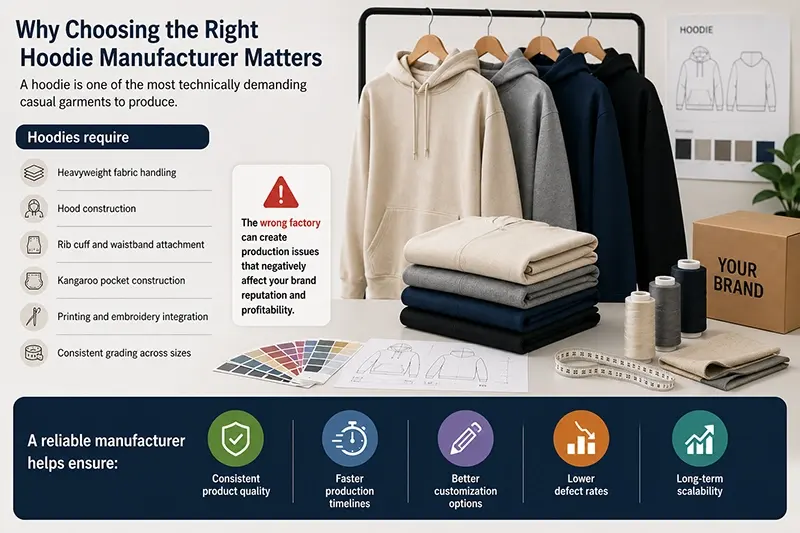
Why Choosing the Right Hoodie Manufacturer Matters
A hoodie is one of the most technically demanding casual garments to produce.
Unlike basic T-shirts, hoodies require:
- Heavyweight fabric handling
- Hood construction
- Rib cuff and waistband attachment
- Kangaroo pocket construction
- Printing and embroidery integration
- Consistent grading across sizes
The wrong factory can create production issues that negatively affect your brand reputation and profitability.
A reliable manufacturer helps ensure:
- Consistent product quality
- Faster production timelines
- Better customization options
- Lower defect rates
- Long-term scalability
1. Define Your Hoodie Product Requirements
Before contacting manufacturers, clearly define your project requirements.
Consider:
- Oversized or regular fit?
- Pullover or zip-up hoodie?
- Lightweight or heavyweight fabric?
- Embroidery or printing?
- Fashion, streetwear, or activewear positioning?
- Target retail price?
The more specific your requirements are, the easier it becomes to identify the right supplier.
Brands that provide clear specifications typically experience smoother development and production processes.
2. Look for Hoodie Manufacturing Experience
Not every apparel factory specializes in hoodie production.
Many garment suppliers focus primarily on T-shirts, dresses, sportswear, or woven products.
An experienced Custom Hoodie Manufacturer will understand:
- Hood construction techniques
- Heavyweight fabric behavior
- Embroidery placement
- Print durability
- Garment washing requirements
- Size grading consistency
Factories with hoodie-specific experience are usually better equipped to handle product development and bulk production.
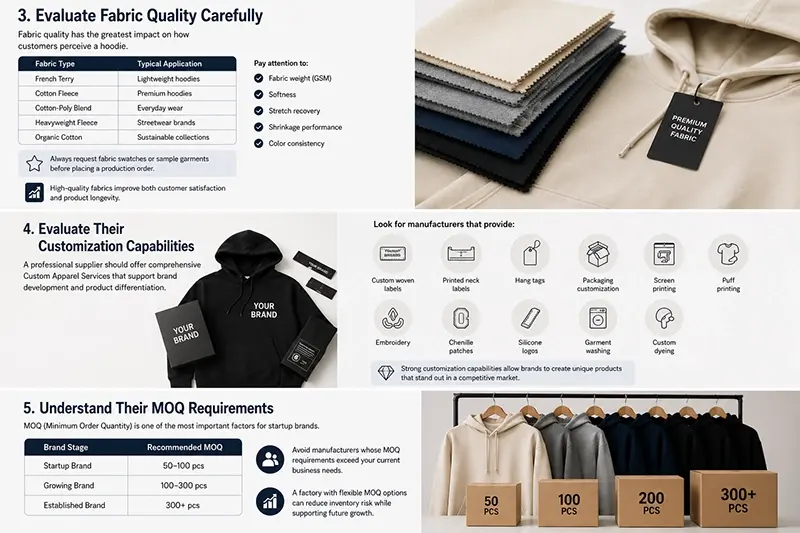
3. Evaluate Fabric Quality Carefully
Fabric quality has the greatest impact on how customers perceive a hoodie.
Common hoodie fabrics include:
| Fabric Type | Typical Application |
|---|---|
| French Terry | Lightweight hoodies |
| Cotton Fleece | Premium hoodies |
| Cotton-Poly Blend | Everyday wear |
| Heavyweight Fleece | Streetwear brands |
| Organic Cotton | Sustainable collections |
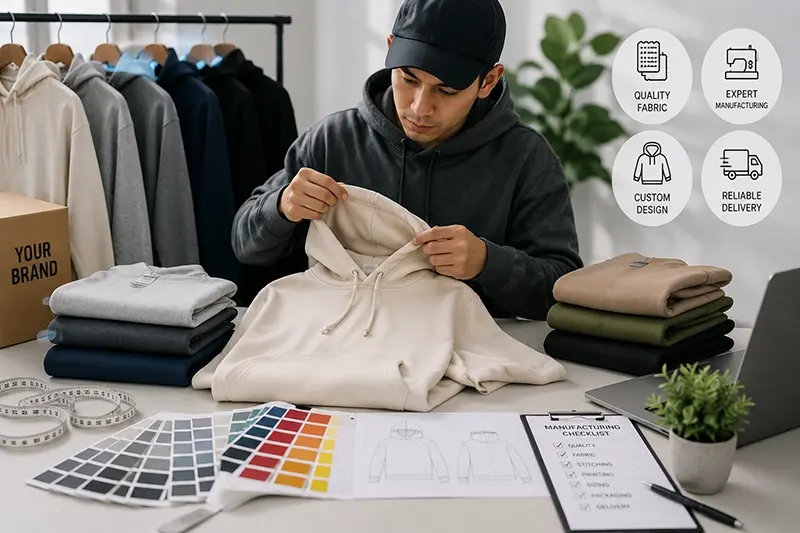
Always request fabric swatches or sample garments before placing a production order.
Pay attention to:
- Fabric weight (GSM)
- Softness
- Stretch recovery
- Shrinkage performance
- Color consistency
High-quality fabrics improve both customer satisfaction and product longevity.
4. Evaluate Their Customization Capabilities
Modern clothing brands need much more than basic garment manufacturing.
A professional supplier should offer comprehensive Custom Apparel Services that support brand development and product differentiation.
Look for manufacturers that provide:
- Custom woven labels
- Printed neck labels
- Hang tags
- Packaging customization
- Screen printing
- Puff printing
- Embroidery
- Chenille patches
- Silicone logos
- Garment washing
- Custom dyeing
Strong customization capabilities allow brands to create unique products that stand out in a competitive market.
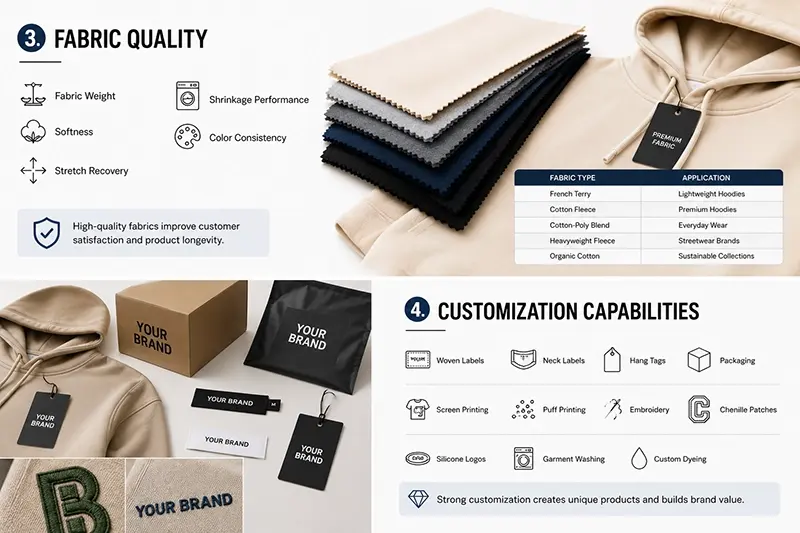
5. Understand Their MOQ Requirements
MOQ (Minimum Order Quantity) is one of the most important factors for startup brands.
Typical hoodie MOQ ranges:
| Brand Stage | Recommended MOQ |
|---|---|
| Startup Brand | 50–100 pcs |
| Growing Brand | 100–300 pcs |
| Established Brand | 300+ pcs |
Avoid manufacturers whose MOQ requirements exceed your current business needs.
A factory with flexible MOQ options can reduce inventory risk while supporting future growth.
6. Request Samples Before Bulk Production
Never skip the sampling stage.
Samples allow you to verify:
- Fabric quality
- Measurements
- Printing quality
- Embroidery quality
- Construction details
- Overall appearance
The sample process is often the best way to evaluate a manufacturer’s professionalism and attention to detail.
A good supplier will work with you to refine the product before bulk production begins.
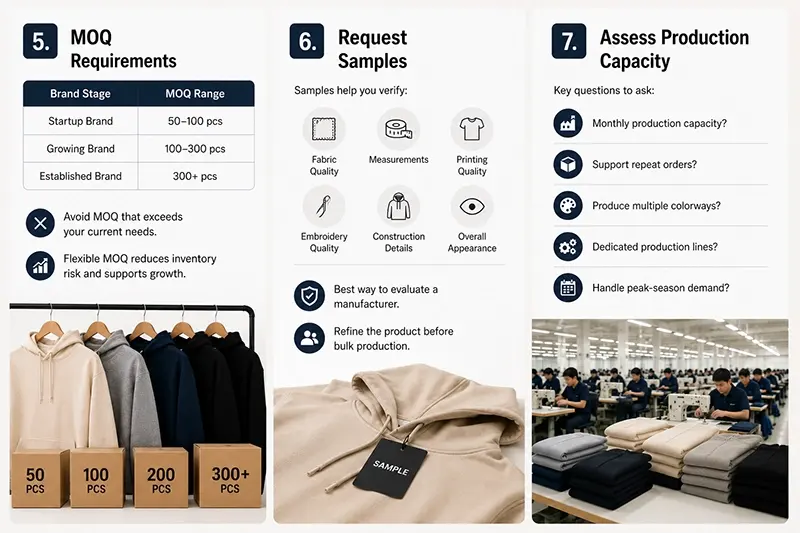
7. Assess Production Capacity
Your manufacturer should be able to grow with your brand.
Ask questions such as:
- What is their monthly production capacity?
- Can they support repeat orders?
- Can they produce multiple colorways?
- Do they have dedicated production lines?
- How do they handle peak-season demand?
Production scalability becomes increasingly important as your brand expands.
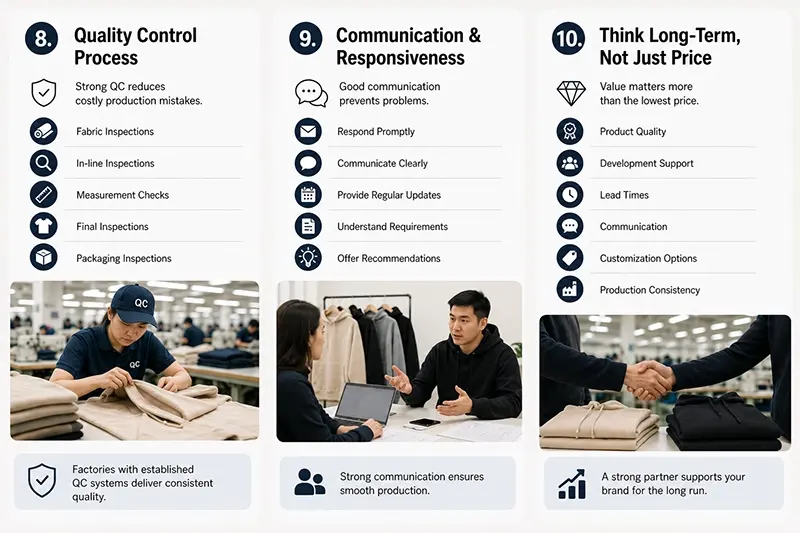
8. Review Their Quality Control Process
Strong quality control systems help reduce costly production mistakes.
Professional manufacturers typically perform:
- Fabric inspections
- In-line production inspections
- Measurement checks
- Final garment inspections
- Packaging inspections
Ask potential suppliers about their quality management procedures.
Factories with established QC systems generally deliver more consistent products.
9. Evaluate Communication and Responsiveness
Many manufacturing problems result from poor communication rather than production capability.
A reliable supplier should:
- Respond promptly
- Communicate clearly
- Provide regular updates
- Understand technical requirements
- Offer production recommendations
Strong communication helps prevent misunderstandings and production delays.
10. Think Long-Term, Not Just Price
The lowest-priced manufacturer is not always the best option.
When comparing suppliers, consider:
- Product quality
- Development support
- Lead times
- Communication
- Customization options
- Production consistency
A strong manufacturing partner can support your brand for years and contribute significantly to long-term business growth.
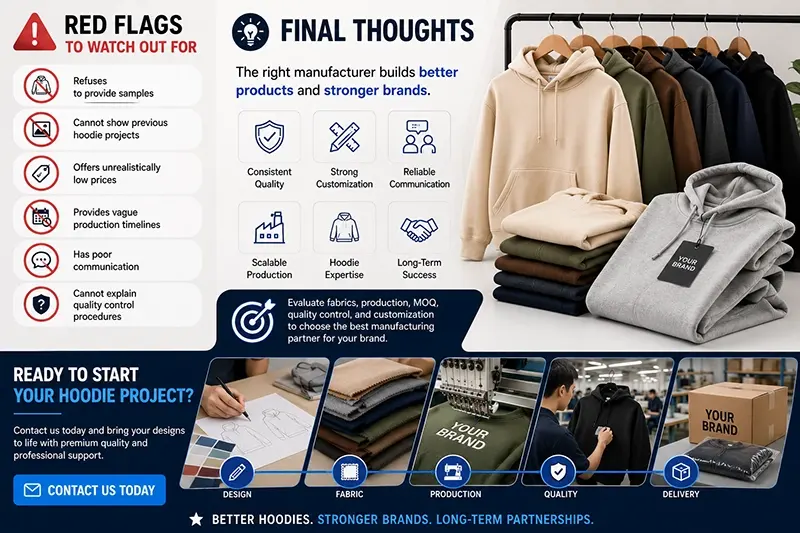
Red Flags to Watch Out For
Be cautious if a manufacturer:
- Refuses to provide samples
- Cannot show previous hoodie projects
- Offers unrealistically low prices
- Provides vague production timelines
- Has poor communication
- Cannot explain quality control procedures
These warning signs often lead to production problems later.
Final Thoughts
Choosing a hoodie manufacturer is one of the most important decisions your clothing brand will make.
The right supplier should offer consistent quality, strong customization capabilities, reliable communication, scalable production capacity, and extensive hoodie manufacturing experience.
By carefully evaluating fabrics, production systems, MOQ requirements, quality control processes, and customization options, brands can significantly reduce production risks and build stronger long-term supplier relationships.
Whether you’re launching your first hoodie collection or expanding an existing apparel line, investing time in selecting the right manufacturing partner will help create better products and a stronger brand.
Ready to Start Your Hoodie Project?
If you’re looking for a reliable hoodie manufacturing partner, Contact Us Today to discuss your designs, fabric requirements, branding options, and production goals.
Our team is ready to help you develop premium custom hoodies that align with your brand vision and target market.
FAQs
How many hoodies should I order for my first production run?
Most startup clothing brands begin with 50–100 pieces per design to test market demand before scaling production.
What is the best fabric weight for custom hoodies?
For most brands, 320–380 GSM fabrics offer the best balance of comfort, durability, and premium appearance. Streetwear brands often choose 400–500 GSM heavyweight fabrics.
How long does custom hoodie production usually take?
After sample approval, bulk production generally takes between 20 and 45 days, depending on order quantity, customization requirements, and factory capacity.
Should I choose a local manufacturer or an overseas manufacturer?
Both options have advantages. Overseas manufacturers often offer more competitive pricing and larger production capacity, while local suppliers may provide faster communication and shorter shipping times.
How can I verify the quality of a hoodie manufacturer?
Request samples, review previous projects, evaluate communication quality, ask about quality control procedures, and verify their experience with similar hoodie products before placing a bulk order.
Share With
Related Articles
Hot Products