How to Choose a Custom Clothing Manufacturer for Your Clothing Brand
Starting a clothing brand is easier than ever. However, building a successful clothing brand requires much more than creative designs, attractive branding, and effective marketing.
One of the most important decisions every apparel entrepreneur will make is choosing the right manufacturing partner.
Many clothing brands struggle with inconsistent quality, production delays, communication issues, and inventory problems because they select a supplier based solely on price. In reality, the manufacturer you choose will directly influence your product quality, customer satisfaction, and long-term growth potential.
At OEM Fashion, we’ve worked with startup brands, fashion retailers, and private label businesses across North America, Europe, and Australia. We’ve seen how the right manufacturing partner can help brands grow faster while reducing costly production mistakes.
This guide explains the most important factors to consider when choosing a clothing manufacturer for your brand.
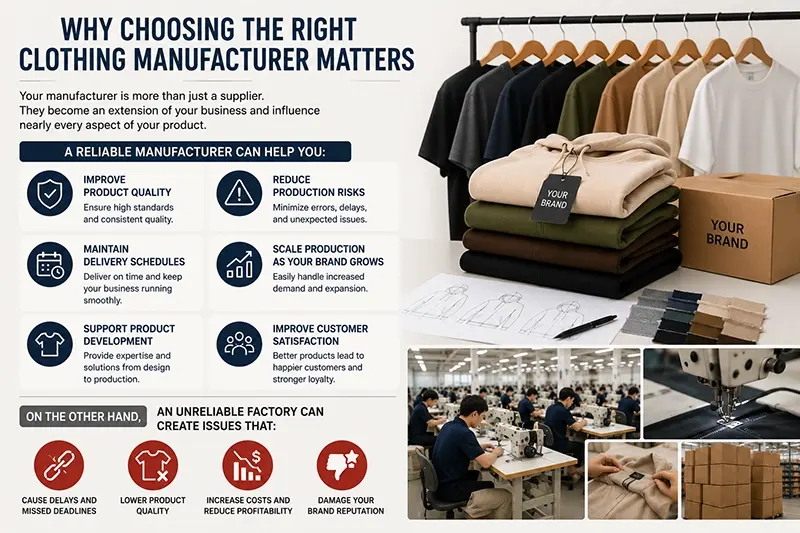
Why Choosing the Right Clothing Manufacturer Matters
Your manufacturer is more than just a supplier.
They become an extension of your business and influence nearly every aspect of your product.
A reliable manufacturer can help you:
- Improve product quality
- Reduce production risks
- Maintain delivery schedules
- Scale production as your brand grows
- Support product development
- Improve customer satisfaction
On the other hand, an unreliable factory can create issues that damage your reputation and reduce profitability.
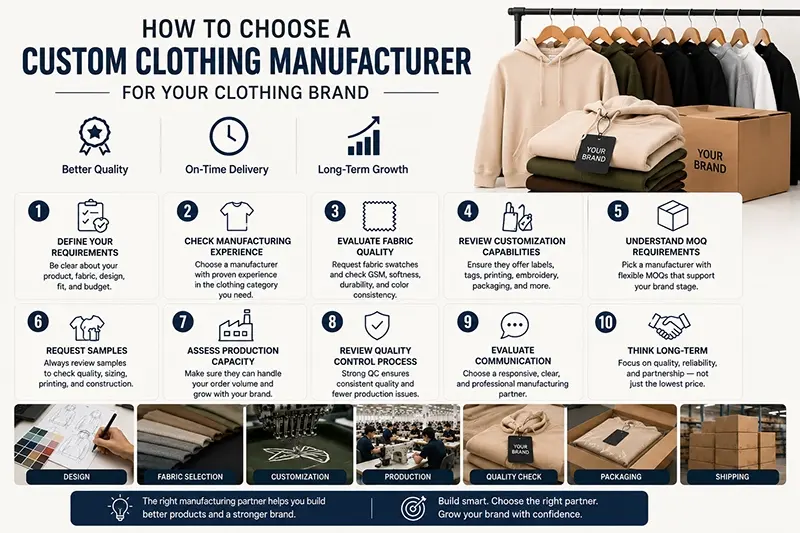
1. Define Your Product Category First
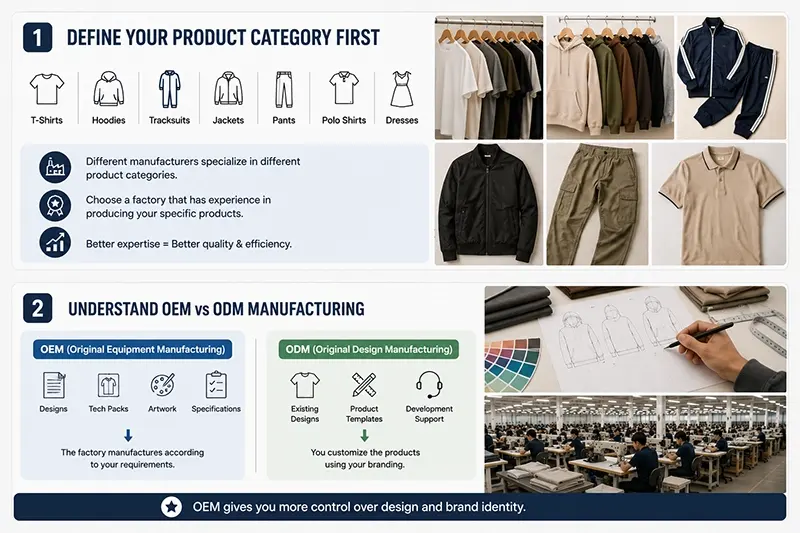
Before contacting any factory, you should clearly understand what products you plan to sell.
Different manufacturers specialize in different product categories.
For example:
- T-Shirts
- Hoodies
- Tracksuits
- Jackets
- Pants
- Polo Shirts
- Dresses
A factory that excels at T-shirt production may not be the best choice for heavyweight hoodies or structured outerwear.
Working with an experienced Custom Clothing Manufacturer that understands your specific product category can significantly improve product quality and production efficiency.
2. Understand the Difference Between OEM and ODM Manufacturing
Not all manufacturers offer the same type of service.
The two most common production models are:
OEM (Original Equipment Manufacturing)
You provide:
- Designs
- Tech packs
- Artwork
- Specifications
The factory manufactures according to your requirements.
ODM (Original Design Manufacturing)
The factory provides:
- Existing designs
- Product templates
- Development support
You customize the products using your branding.
Most fashion brands looking to build unique products prefer OEM manufacturing because it offers greater control over design and brand identity.
3. Evaluate Product Development Capabilities
Manufacturing starts long before bulk production.
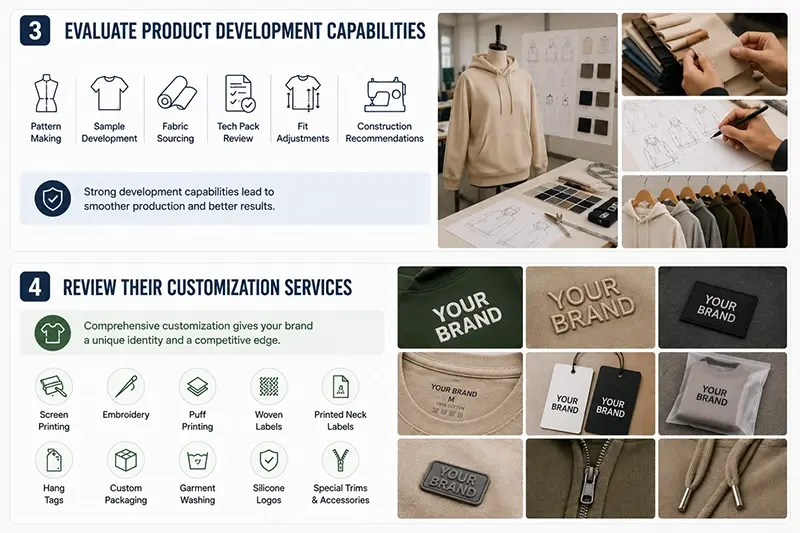
A professional factory should provide strong product development support.
Look for capabilities such as:
- Pattern making
- Sample development
- Fabric sourcing
- Tech pack review
- Fit adjustments
- Construction recommendations
Strong development capabilities often result in fewer production problems later.
4. Review Their Customization Services
Modern clothing brands require more than basic garment production.
Many successful brands work with suppliers that offer complete Custom Apparel Services, helping them create a consistent and professional brand image.
Common customization options include:
- Screen printing
- Embroidery
- Puff printing
- Woven labels
- Printed neck labels
- Hang tags
- Custom packaging
- Garment washing
- Silicone logos
- Special trims and accessories
A manufacturer with extensive customization capabilities can help your products stand out in competitive markets.
5. Check Their Minimum Order Quantity (MOQ)
MOQ requirements vary significantly between factories.
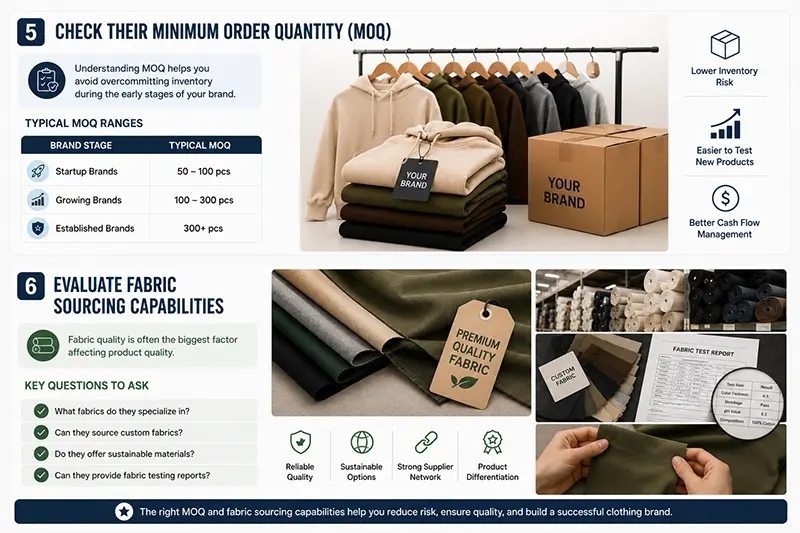
Understanding MOQ helps you avoid overcommitting inventory during the early stages of your brand.
Typical MOQ ranges include:
| Brand Stage | Typical MOQ |
|---|---|
| Startup Brands | 50–100 pcs |
| Growing Brands | 100–300 pcs |
| Established Brands | 300+ pcs |
Choosing a manufacturer with reasonable MOQ requirements allows you to test products while managing risk.
6. Evaluate Fabric Sourcing Capabilities
Fabric quality is often the biggest factor affecting product quality.
A strong manufacturer should have access to reliable fabric suppliers and sourcing networks.
Ask questions such as:
- What fabrics do they specialize in?
- Can they source custom fabrics?
- Do they offer sustainable materials?
- Can they provide fabric testing reports?
Strong sourcing capabilities give brands greater flexibility and product differentiation.
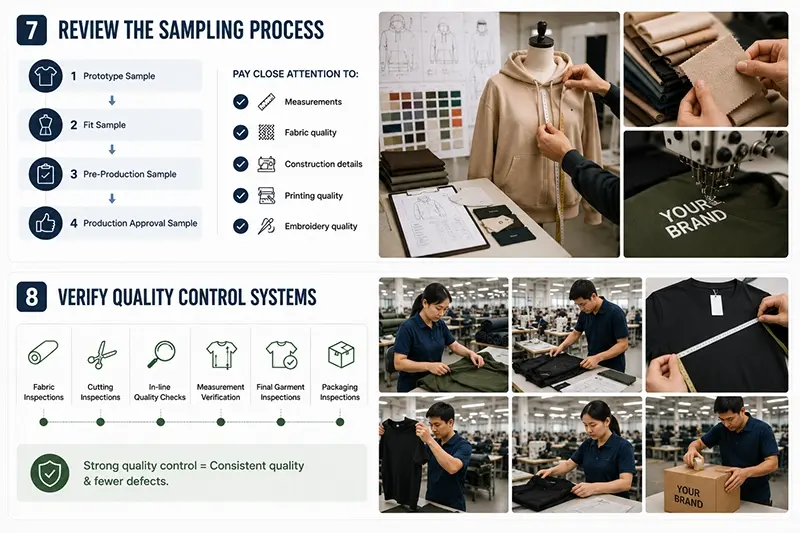
7. Review the Sampling Process
Never skip product sampling.
Sampling helps identify potential issues before bulk production begins.
A typical development process may include:
- Prototype Sample
- Fit Sample
- Pre-Production Sample
- Production Approval Sample
Pay close attention to:
- Measurements
- Fabric quality
- Construction details
- Printing quality
- Embroidery quality
The sampling process often reveals how professional and responsive a manufacturer truly is.
8. Verify Quality Control Systems
Quality control should be built into every stage of production.
Professional manufacturers typically perform:
- Fabric inspections
- Cutting inspections
- In-line quality checks
- Measurement verification
- Final garment inspections
- Packaging inspections
Factories with strong quality control systems generally deliver more consistent products and fewer defects.
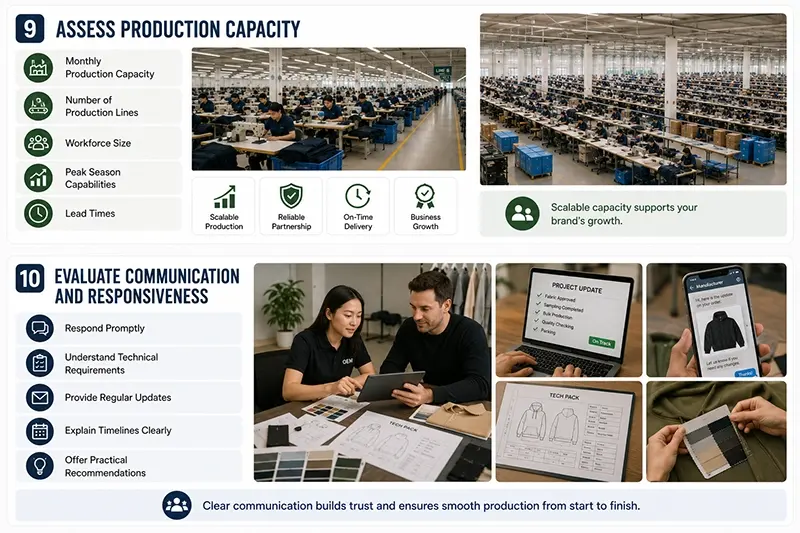
9. Assess Production Capacity
Your manufacturer should be able to support future growth.
Ask about:
- Monthly production capacity
- Number of production lines
- Workforce size
- Peak season capabilities
- Lead times
A factory that can scale with your business becomes a valuable long-term partner.
10. Evaluate Communication and Responsiveness
Poor communication is one of the most common causes of production problems.
A reliable manufacturer should:
- Respond promptly
- Understand technical requirements
- Provide regular updates
- Explain production timelines clearly
- Offer practical recommendations
Strong communication helps reduce misunderstandings and improves overall project management.
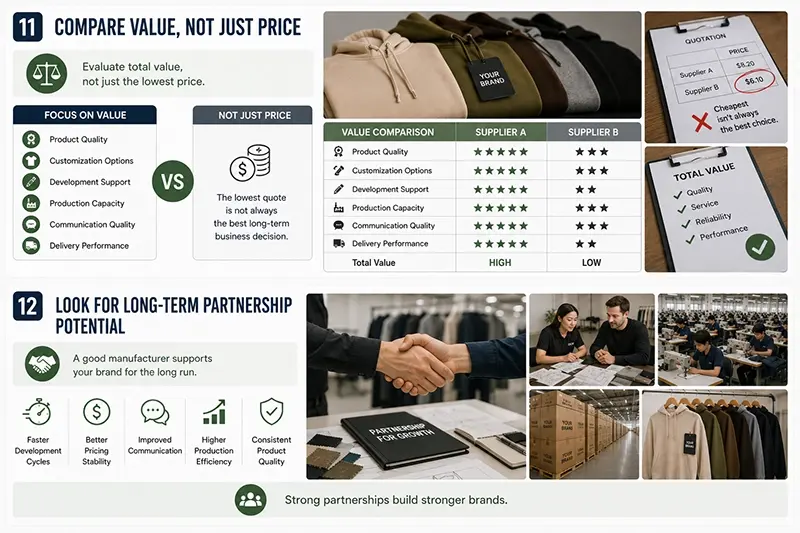
11. Compare Value, Not Just Price
Many brands make the mistake of selecting the cheapest supplier.
Instead of focusing only on price, evaluate:
- Product quality
- Customization options
- Development support
- Production capacity
- Communication quality
- Delivery performance
The lowest quote is not always the best long-term business decision.
12. Look for Long-Term Partnership Potential
A good manufacturer should be able to support your brand for years, not just a single order.
Long-term partnerships often provide:
- Faster development cycles
- Better pricing stability
- Improved communication
- Higher production efficiency
- Consistent product quality
The strongest apparel brands typically work with trusted manufacturing partners over extended periods.
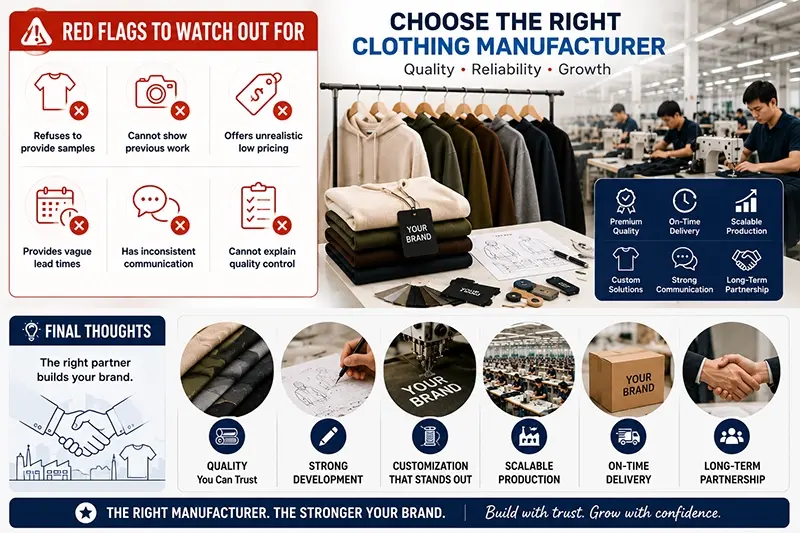
Red Flags to Watch Out For
Be cautious if a manufacturer:
- Refuses to provide samples
- Cannot show previous production work
- Offers unrealistically low pricing
- Provides vague lead times
- Has inconsistent communication
- Cannot explain quality control procedures
These warning signs often lead to production problems later.
Final Thoughts
Choosing the right clothing manufacturer is one of the most important decisions your brand will make.
The ideal partner should provide reliable quality, strong product development support, flexible customization capabilities, scalable production capacity, and clear communication throughout the manufacturing process.
By carefully evaluating manufacturing expertise, quality control systems, sourcing capabilities, MOQ requirements, and long-term partnership potential, brands can significantly reduce production risks and build a stronger foundation for future growth.
Whether you’re launching your first collection or expanding an existing apparel business, investing time in selecting the right manufacturing partner can have a lasting impact on your success.
Ready to Start Your Clothing Brand?
If you’re looking for a reliable manufacturing partner for custom apparel development, private label production, and scalable garment manufacturing, Contact Us Today to discuss your project requirements.
Our team is ready to help bring your ideas from concept to production.
FAQ
What is the minimum order quantity for a clothing manufacturer?
Most clothing manufacturers offer MOQs ranging from 50 to 300 pieces per style, depending on the product type, fabric requirements, and customization complexity.
What is the difference between OEM and ODM clothing manufacturing?
OEM manufacturing allows brands to provide their own designs and specifications, while ODM manufacturing uses pre-developed factory designs that can be customized with branding.
How long does clothing production usually take?
How can I verify the quality of a clothing manufacturer?
How can I verify the quality of a clothing manufacturer?
Request samples, review previous production work, evaluate communication quality, ask about quality control systems, and verify their experience with similar products.
Should startups work with overseas clothing manufacturers?
Many startup brands choose overseas manufacturers because they often offer lower production costs, wider customization options, and scalable manufacturing capacity.
Share With
Related Articles
Hot Products